Review: Serious Sam: Tormental
Store page / View this review on Steam
I can’t really imagine trying to balance a roguelike. More than any other genre, roguelikes live and die on the razor’s edge of difficulty. Too easy, and people blow through it in a few runs. Too hard, and frustration claims most of your would-be player base. It took me awhile to come around to the balance struck in Serious Sam: Tormental. There are some choices here that I wouldn’t have made, and some mechanics that weren’t immediately apparent despite how important they were. Still, it’s solid enough to take more than a few hours from me, and I will admit that every time I came close to frustration, I discovered something that kept me going. If you’re down for that kind of rollercoaster, read on.

I’ll give Tormental credit for somehow having one of the more unique premises for a Serious Sam game. Somehow, Sam “Serious” Stone has been transported into the mind of the mighty Mental himself, and must fight his way through the memories and imaginings of his arch-nemesis to reach the secrets locked away in his vile psyche. All sorts of nightmare beasts roam the imagined halls, along with strange new weapons and powers for Sam to claim as his own. But there are also unexpected allies to find here, other figments of twisted imagination that will provide guidance, clues, or challenges that will help our boy gain the power and knowledge he needs to beat Mental from the inside out.
There are certainly clever elements to the presentation that bear out from the concept. Everything has a cartoonish, dreamlike quality to it, especially the enemies which feel more like simple ideas of enemies rather than direct pulls from the other games in the series. Mental has “moods”, which translate into unique difficulty modifiers for each area that you can manipulate to get the challenge you want. The meta-progression also takes on a new dimension as you hunt keys to clear the big mental block at the center of Mental’s psyche, and this is done by far more than just beating runs. You even get some clever twists on existing characters, like the strange robotic presence that Mental envisions Netrisca as being.

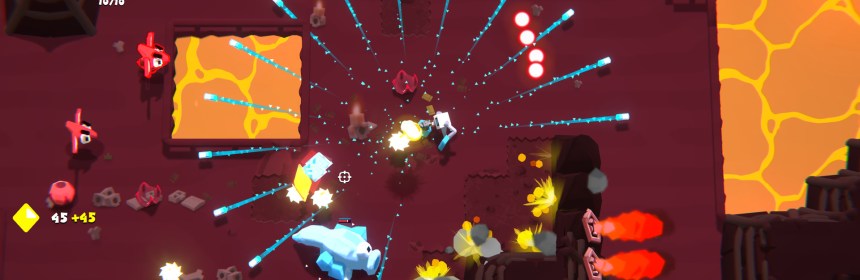
Beyond that, Tormental is exactly the kind of run-and-gun top-down romp popularized by Nuclear Throne and Enter the Gungeon. Sam enters a dungeon that is a short, linear sequence of randomized rooms, he kills all the monsters, hoovers up all the loot, beats the boss, and moves on to the next. “Linear” is an important factor here, as there is none of the exploration or multiple routes that you might expect from a game in this style. You’ll find loot, keys, chests, shops, and some unique rewards behind locked doors, but it’s still very much a straight shot through to the boss. Weapons are another departure from both top-down roguelikes and other Serious Samses. Your main gun is a pea-shooter with unlimited ammo (unless you opt for a mood that changes that), and you earn modifiers to it like rapid fire or ricochets by beating the bosses. Other weapons like shotguns and grenade launchers are secondary weapons, which you can have many of but only equip one at a time, and their ammo is very limited.
It’s the mechanics where this game really sets itself apart, and as I’ve already illustrated it does so in mixed ways. Bombs are a big part of the game though you cannot place them yourself. They appear in almost every room, and they can be swatted around with your melee weapon to blow up enemies. Even some of the perks you pick up affect bombs directly. Your dodge roll is HUGELY important, as dodge rolling through weakened enemies is a “brutal” kill that nets you bonus items. It’s never really emphasized just how important it is, but the economy of the entire game is balanced around you brutal killing most of your foes for extra health and keys. This is also where I can mention the less forgiving aspects of the design, like the absolutely absurd amount of damage many of the most common attacks do, and the fact that pickups vanish a few seconds after they appear. I particularly hate that last one, because it means not only do you have to do a careful dance of death to survive each room, you have to do it as close to the foes you’re killing as possible, and ALSO be near the exit when the last one dies, because bonus items will spawn there for only a few moments.

In the end, I definitely enjoy Serious Sam: Tormental, but every run I have to question some of the decisions that went into it. The vanishing rewards are the most common one, but I’ve also lost too many runs only because I tried to Brutal kill everything and the chaos of battle meant I took contact damage and died while doing so. Outside of spotty mechanics, though, it’s a perfectly solid roguelike shooter, and I do appreciate the unique hook and meta-progression. It looks and sounds great as well, even if some fights get a little cluttered with bulky enemies and bullet-hell-style attacks. If you’re ready for a steep learning curve and need something different from the current crop of roguelikes, I’d say give this one a serious try.


Thanks for this thoughtful review — your opening point about roguelike balance really resonated with me. Tormental does live on that razor’s edge: too easy and a run feels disposable, too punishing and the frustration takes over, and I agree that it takes a while to appreciate the balance it settles on. The premise also stood out to me, with Sam fighting through Mental’s mind, memories and imagined allies, and I liked how you connected that idea to the cartoonish, dreamlike presentation and the moods that let players manipulate each area’s difficulty modifiers. The key-hunting meta-progression toward the central mental block gave my runs a purpose beyond simply reaching the next boss, which is not always true of top-down shooters in the Nuclear Throne and Enter the Gungeon mold. I also found your mechanical analysis convincing: the unlimited-ammo pea-shooter with boss-earned modifiers, the limited-ammo secondary weapons, bombs that must be swatted with melee, and especially the dodge-roll brutal kills that quietly drive the economy for health and keys. Those systems explain why the game can feel both clever and unfair at once, particularly when pickups vanish quickly, common attacks hit very hard, and chasing a brutal kill can end a run through contact damage. Your conclusion feels fair — a solid, distinctive roguelike shooter with a steep learning curve, some cluttered bullet-hell moments, and a hook worth trying despite its rough edges. https://poke-bonk.online/
LikeLike